
If you’ve started avoiding tank tops, cringing at photos where your arms are raised, or tugging at sleeves to hide loose skin, you already know the frustration. Diet and exercise can tone the muscle underneath, but they can’t tighten skin that has lost its elasticity – whether from aging, weight loss, or genetics. For mild to moderate sagging limited to the upper arm, a short-scar arm lift can smooth things out with a much smaller incision. For more significant, hanging skin that extends toward the elbow, a traditional arm lift (full brachioplasty) removes more tissue and delivers a more dramatic, longer-lasting reshape. The right choice comes down to how much excess skin you’re dealing with and how much scarring you’re willing to trade for tighter arms.
A short-scar arm lift, sometimes called a mini brachioplasty, targets skin laxity that’s concentrated near the armpit and upper third of the arm. The incision is placed in or near the armpit crease, which keeps it hidden when your arm is at your side. This approach works well for patients who have some skin looseness, perhaps from modest weight loss or early signs of aging, but who don’t have the crepey, hanging skin that runs the full length of the arm.
It’s often paired with arm liposuction to remove stubborn fat pockets at the same time, giving the arm a more contoured shape rather than just tighter skin.
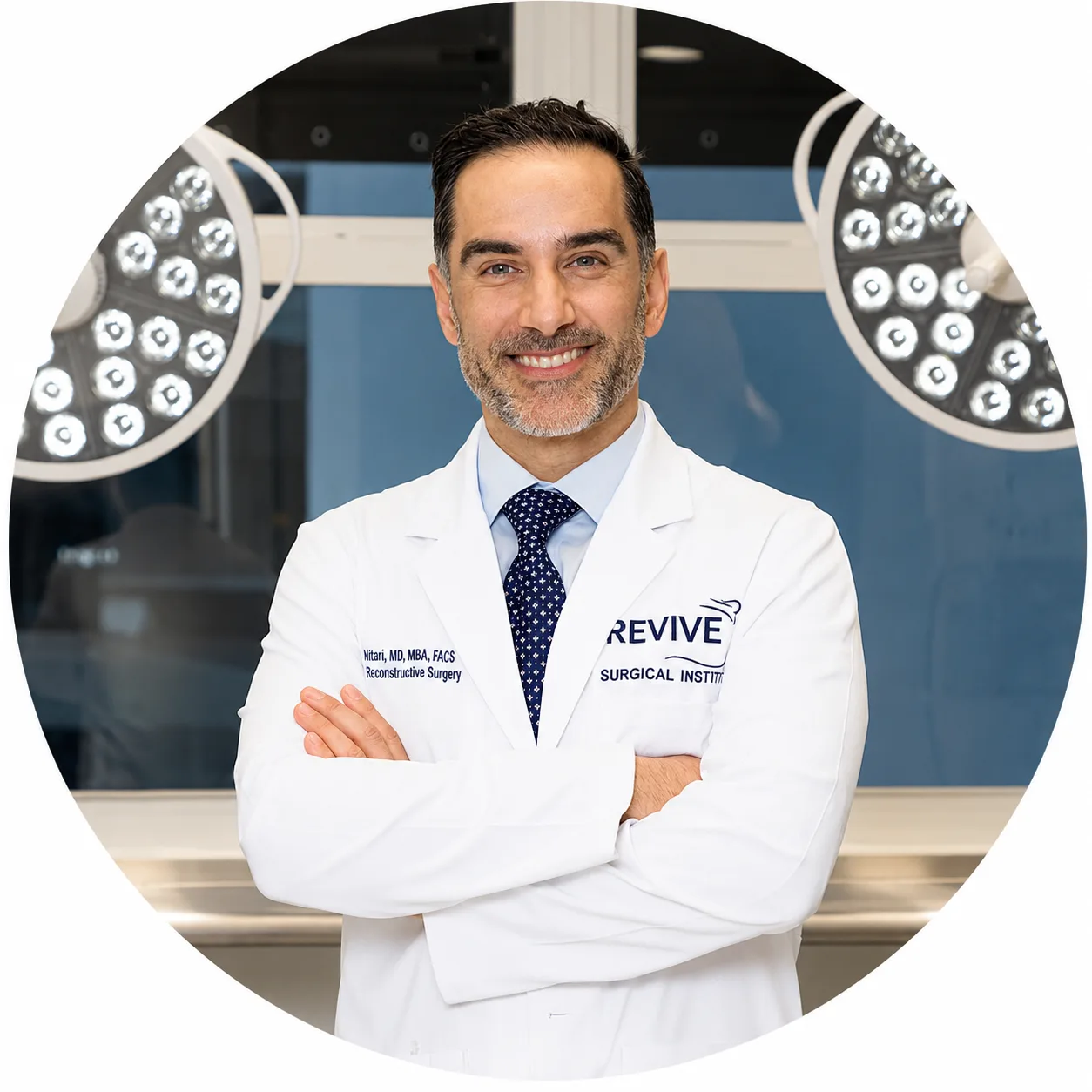
“A lot of patients come in assuming arm lift surgery automatically means a long scar down to the elbow. That’s not always the case. If someone’s laxity is really concentrated near the armpit, we can often address it through a much shorter incision and still get a result they’re thrilled with,” says Dr. Morad Askari, MD, MBA, FACS, board-certified plastic surgeon and founder of Revive Surgical Institute.
The trade-off is scope. A short scar approach can’t remove large amounts of hanging skin, so if you pinch your arm and there are several inches of loose tissue, this technique likely won’t get you all the way there.
The traditional, or full, brachioplasty is designed for more substantial skin excess – the kind that’s common after major weight loss or significant aging-related changes. The incision runs from the armpit down toward the elbow, usually along the inner arm where it’s less visible in everyday clothing. Because the incision is longer, the surgeon can remove considerably more excess skin and reshape the entire arm contour, not just the upper portion.
“For patients who’ve lost a large amount of weight, the skin often loses its ability to snap back on its own. In those cases, a longer incision isn’t a compromise, it’s what actually gets them the smooth, toned arm they’re picturing,” Dr. Askari explains.
Good candidates for a full brachioplasty typically have:
Skin that hangs or sways noticeably when the arm is extended
Excess tissue extending from the armpit to at or near the elbow
Minimal remaining skin elasticity, so lifestyle changes alone won’t resolve it
Realistic expectations about trading a longer scar for a more complete correction

This is the most obvious difference. A short-scar arm lift keeps the incision tucked in the armpit, largely hidden by arm position and most clothing. A full brachioplasty scar runs along the inner arm and is more visible, though it’s placed to fade and lighten considerably over the first year. Scar quality also depends on genetics and aftercare, which is why some patients pair either procedure with professional scar management to support smoother healing.
Recovery scales with the extent of surgery:
Short-scar arm lift: most patients feel comfortable resuming light daily activity within a week or so, with full recovery in around 2 to 3 weeks
Traditional arm lift: initial downtime tends to run 2 weeks before returning to desk work, with strenuous activity and heavy lifting restricted for 4 to 6 weeks
Both procedures involve temporary swelling, bruising, and some tightness as the tissue settles
Once healed, both approaches produce results that hold up well over time, provided your weight stays relatively stable. The skin that’s removed doesn’t come back, though normal aging will continue at its own pace. Patients who’ve had a full brachioplasty after major weight loss often describe the change as one of the more visible transformations in their entire journey, simply because there was more excess to correct.
“What I tell people is that the scar isn’t the whole story. It’s one line on an arm that finally moves the way you want it to, in a sleeve, in a swimsuit, in a photo where you’re not thinking about hiding anything,” Dr. Askari says.
There’s no universal answer, but a few honest questions can point you in the right direction:
Is your loose skin mostly near the armpit, or does it extend most of the way to your elbow?
Would you rather accept a longer scar for a more complete result, or prioritize a shorter, more discreet incision even if it means a smaller change?
Have you reached a stable weight, or are you still losing?
Are you combining this with other procedures, such as body contouring or a broader post-weight-loss plan?
A physical exam is really the only reliable way to determine which technique fits your anatomy. Photos and self-assessments at home tend to underestimate or overestimate laxity, whereas skin behaves differently when you actually pinch it and move the arm through a full range of motion.
“I’d rather spend extra time in consultation making sure someone understands both options than have them choose based on what a scar looks like in a photo online. Every arm is different, and the surgical plan should be too,” Dr. Askari notes.
A few things about arm skin and surgery that tend to get left out of the usual explanations:
The skin on the inner upper arm is among the thinnest on the entire body, which is part of why it loses elasticity faster than skin elsewhere and why it’s often one of the first places people notice sagging.
Arm skin has fewer oil-producing glands than skin on the torso, which is part of why moisturizing and scar care matter more here than in most other post-surgical areas.
Because the inner arm isn’t constantly exposed to sun the way the face and hands are, scars in this location often fade to a finer, paler line over time compared to scars on more sun-exposed skin.
If you’re weighing a short-scar approach against a traditional arm lift, the most useful next step is an in-person evaluation in which your skin, goals, and medical history all factor into the plan. We also welcome patients traveling from out of town for surgery and offer flexible financing options to make the procedure more accessible. Whichever technique ends up being the right fit, the goal is the same: arms you feel comfortable in, without a second thought.
Disclaimer: This article is for general informational purposes only and does not constitute medical advice. Individual results vary, and candidacy for any surgical procedure can only be determined through an in-person consultation with a board-certified plastic surgeon. Please consult a qualified medical professional to discuss your specific health history, goals, and treatment options before making any decisions about surgery.