
Sculptra® generally provides longer-lasting results – up to two years or more – while Alloclae® offers earlier visible improvement and a regenerative, allograft-based approach that typically lasts anywhere from 12 months to several years. The choice between Alloclae® and Sculptra® depends on your skin quality, treatment area, degree of volume loss, and how quickly you want to see results.
Alloclae® is a newer injectable in the regenerative aesthetics category. It is derived from donated human tissue, which is processed and sterilized to leave behind a supportive matrix. It works with your biology, making it a biostimulator and regenerative injectable rather than a hyaluronic acid product.
Once placed in the correct tissue plane, Alloclae® provides a biological scaffold of proteins and growth factors. Fibroblasts migrate into that scaffold and lay down new collagen and elastin over the following weeks and months. The scaffold is gradually replaced by your own living tissue. There is usually a mild immediate improvement from the injected volume itself, which settles as the regenerative effect takes over, with most patients noticing steady change between one and three months.
Matrix-based, not gel-based. Structural support instead of static volume.
Provides immediate structure. Patients see an initial improvement in volume and contour right after treatment.
Biocompatible scaffold. Creates a welcoming environment for your body to build long-term tissue.
Natural integration. The final result is composed of your own cells, offering a uniquely natural feel.
Broad tissue improvement. Patients frequently describe better skin texture and glow, not just fewer lines.
Layered use. Complements other treatments, including dermal fillers placed for contour and projection.
Natural progression. Gradual change means results look unforced.
Alloclae® is offered as a consultation-based service so candidacy can be confirmed in person.
Sculptra® is a poly-L-lactic acid (PLLA) injectable with a long track record in aesthetic medicine. It is a collagen stimulator, not a traditional wrinkle filler.
PLLA microparticles are suspended in a liquid carrier. The carrier absorbs within days, and the particles remain temporarily in the deep dermis, triggering fibroblasts to produce new type I collagen. Over several months, the PLLA is fully metabolized, leaving behind a supportive framework of your own collagen.
Very little happens in the first two weeks.
Improvement typically becomes visible around six to eight weeks.
Results continue building for four to six months after the final session.
Most plans involve a series of sessions spaced roughly four to six weeks apart.
It’s also a cornerstone of many non-surgical facelift plans.
Biostimulants are most effective where the problem is thinning and deflation across a broad area, rather than a sharp definition.
Common treatment areas include:
Hollow temples
Sunken or flattened cheeks and mid-face
Nasolabial folds (smile lines)
Marionette lines
Jawline contouring and crepey skin along the jaw and neck
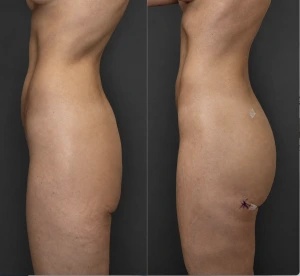
Buttocks augmentation (the “Sculptra BBL”)
Off-face areas such as the chest, upper arms, and above the knees
Both are regenerative rather than purely volumizing, but they get there in different ways.
The practical difference: Sculptra® is a slower, more architectural build. Alloclae® shows earlier signs of improvement and is often described as improving skin quality alongside volume.
Sculptra® is most commonly used for:
Temple hollowing
Mid-face and cheek flattening
Nasolabial folds and marionette lines
Diffuse, age-related volume loss across broad planes of the face
Off-face areas such as crepey skin on the chest, upper arms, and above the knees
Alloclae® is generally used for:
Overall facial skin thinning and dullness
Fine lines and early laxity
Volume support and defined structure in the mid-face
Patients who want some immediate visible correction while regenerative effects take hold
Patients who prefer a regenerative option over synthetic gel fillers
Both can be part of a nonsurgical facial plan alongside neuromodulators, laser resurfacing, or broadband light treatments for tone and pigmentation.
Both have a strong safety record when administered by an experienced injector. Expect the ordinary short-term effects of any injection – temporary redness, swelling, tenderness, or small bruises – typically resolving within a few days.
Alloclae® is derived from human tissue that is rigorously screened and sterilized.
Sculptra® requires proper dilution and injection technique to avoid nodule formation, and post-treatment massage is an important part of the protocol for even distribution.
Technique matters more than product choice: correct depth, dilution, massage instructions, and session spacing are what produce smooth, even results.
Because Alloclae® works by supporting your own tissue regeneration, longevity is tied to the collagen and elastin your body produces. Patients generally see improvement that holds for roughly a year to several years – and because the final result is your own living tissue, results can extend further still.
Sculptra® is documented to last up to two years, and many patients report visible benefit beyond that. Once the PLLA is metabolized, the collagen your body built is genuinely yours – it ages at your natural rate rather than dissolving on a schedule.
That’s the strongest argument in Sculptra®’s favor for longevity. The trade-off is time: several months and multiple sessions before the full result. Maintenance treatments can extend results even further.
Age, metabolism, and baseline collagen. Younger tissue responds more vigorously; faster metabolisms may process product differently.
Sun exposure. Unprotected sun breaks down new collagen. Daily SPF is not optional.
Smoking and nicotine. Both impair collagen synthesis and shorten results.
Weight fluctuation. Significant loss can re-hollow a face treated at a higher weight.
Treatment area. Areas with more movement may see results diminish slightly faster than static areas.
Total volume treated. Under-treating a deflated face yields a shorter-lived result, regardless of the product.
Number of treatments. Both products often require a series of initial sessions for optimal outcomes.
Skincare and maintenance. Consistent medical-grade skincare and periodic touch-ups meaningfully extend results.
Ultimately, both Alloclae® and Sculptra® can deliver natural-looking, long-term improvements, but they offer different advantages. Sculptra® has the edge in established, predictable longevity, with results often lasting two years or more, while Alloclae® may provide earlier visible improvement alongside its regenerative, allograft-based approach. The best choice depends on your individual anatomy, skin quality, treatment goals, and desired timeline.
A consultation with an experienced provider can help determine which option – or combination of treatments – will deliver the most natural and lasting result for you.