When migraines take over most days of the week and medication has stopped making a real difference, migraine surgery may offer a lasting way to reduce how often they strike, how hard they hit, and how long they last. At Revive Surgical Institute in Coral Gables, board-certified plastic surgeon Dr. Morad Askari evaluates each patient carefully, works alongside their neurologist, and recommends surgery only when the evidence points to a good chance of meaningful relief.

Migraine surgery, also called nerve decompression or trigger site surgery, treats migraines that start where small sensory nerves in the head and neck are squeezed or irritated by surrounding muscle, blood vessels, or tissue. By gently releasing the pressure on those nerves, the surgery aims to stop them from setting off attacks.
It does not replace your neurologist or a proper migraine diagnosis. It is an option for selected patients whose migraines keep coming back despite medication, and whose attacks consistently begin in specific, identifiable spots.
Pain that starts above the eyes or between the eyebrows often involves the supraorbital and supratrochlear nerves, which pass through the muscles that create frowning. Releasing these nerves is commonly done through a small incision hidden in the natural crease of the upper eyelid.
Migraines that begin at the side of the head may involve small nerve branches in the temple region. Depending on the branch involved, the surgeon may release it or address the nearby structures irritating it, using small incisions placed within the hairline.
Pain that starts at the base of the skull and travels upward is often linked to the greater occipital nerve as it passes through neck muscle and near a small artery. A discreet incision at the back of the scalp allows the nerve to be freed along its path.
Some migraines begin behind the eyes and are related to contact points inside the nose, such as a deviated septum. When this trigger is suspected, your evaluation may include imaging and coordination with an ear, nose, and throat specialist.

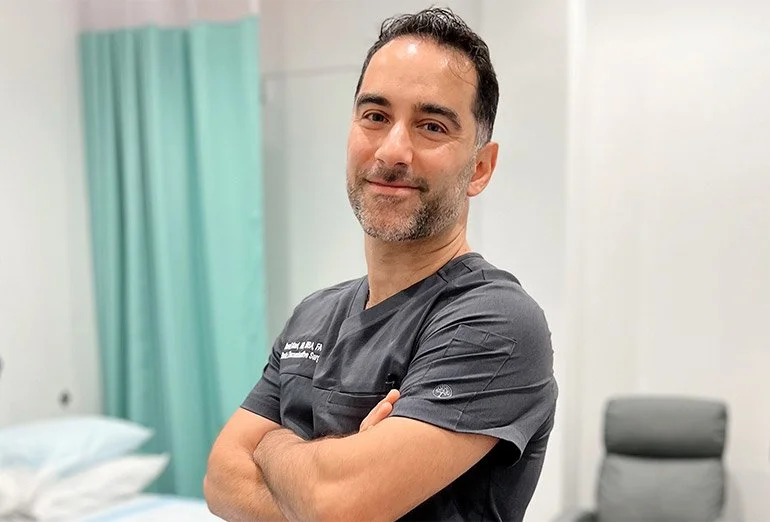
Migraine surgery is delicate nerve work, and it calls for a surgeon who is comfortable operating around small nerves. Dr. Morad Askari, MD, MBA, FACS, is a board-certified plastic surgeon with more than 15 years of experience whose practice includes reconstructive hand surgery and microvascular reconstruction, both built on precise work with fine nerves and vessels.
He completed a fellowship at the Mayo Clinic, trained at the University of Southern California, and served as an Associate Professor at the University of Miami, where he authored numerous scientific articles. Newsweek named him one of America’s Best Plastic Surgeons for 2025 and 2026. Just as important, he gives every migraine patient an honest assessment of whether surgery is likely to help them.
Not everyone with migraines is a candidate, so the consultation is the most important step. Dr. Askari reviews your diagnosis, how often your migraines happen, where each attack starts, and which treatments you have already tried. To make the most of the visit, bring your neurologist’s notes, a list of current and past medications, a headache diary if you keep one, and records of any Botox injections or nerve blocks and how you responded to them. A clear, consistent pattern of where your pain begins is one of the strongest signs that surgery may help. If surgery is not the right fit, you will hear that directly.
Migraine surgery is typically performed as an outpatient procedure under general anesthesia, so you can go home the same day with a responsible adult. How long it takes depends on how many trigger sites are treated.
Incisions are small and placed where they are least visible: in the upper eyelid crease for the forehead, within the hairline for the temples, and at the back of the scalp for the occipital area.
Through these incisions, the surgeon releases the muscle, tissue, or small blood vessels pressing on the nerve, giving it room so it is no longer irritated. The approach is tailored to the trigger sites identified during your evaluation.
The incisions are closed carefully to support healing and keep scars discreet, and you are given detailed instructions for caring for them at home.
Expect some swelling, tenderness, and possibly bruising at the treated sites. Pain medication and cold compresses help, and keeping your head elevated while resting reduces swelling.
Many patients return to desk work and light daily activities within about one to two weeks, depending on how many sites were treated. Avoid strenuous exercise and heavy lifting until you are cleared.
Swelling continues to settle. Temporary numbness, tingling, or itching around the treated areas is common as the nerves recover, and it usually fades gradually.
Improvement can build over several months, so results are best judged over time. Keeping a headache diary during this period helps you, Dr. Askari, and your neurologist see how frequency, severity, and duration are changing.

Dr. Askari works closely with your neurologist to confirm the migraine diagnosis, review the treatments you have tried, and make sure surgery fits into your overall care plan.
Your neurologist stays part of your care. Together, we track how your migraines respond and decide when, and whether, it makes sense to adjust preventive or rescue medications.
Migraine surgery is one part of a bigger plan, not a replacement for ongoing neurological care. Keeping both teams informed helps ensure continuity and the best chance at a lasting result.
Find out whether migraine surgery is a realistic option for you with an honest, in-depth consultation.

The best candidates have a confirmed migraine diagnosis and frequent, disabling attacks that have not responded well enough to standard treatment. Candidacy is decided during your consultation, not before. Good candidates often include:
Migraine surgery is not a guaranteed cure, and no honest surgeon will promise that your migraines will disappear. Published research shows that most patients see around an 80% improvement in how often their migraines occur, how severe they are, and how long they last. A small percentage of patients become migraine-free. Others improve less, by around 50% or, in some cases, 10%. For someone who lives with severe migraines nearly every day, even a partial improvement can mean getting back days with family, at work, and doing what they enjoy.
Migraine surgery in the United States typically costs between $5,000 and $15,000, according to the American Society of Plastic Surgeons. That range includes the surgeon’s fee, anesthesia and the surgical facility. In Florida, published prices start at around $14,000 per trigger site, so treating two or more sites costs more than treating one. Your price depends on how many trigger sites are treated, anesthesia, and facility fees. Migraine surgery is currently self-pay at Revive Surgical Institute, as it is not yet covered by insurance. You will receive a personalized quote after your consultation, and patient financing is available to help spread out the cost.
Schedule a consultation with Dr. Askari to find out whether you are a candidate and what your treatment would involve.
Revive Surgical Institute performs surgery in its QUAD-A accredited surgical center in Coral Gables, where patient safety is the first priority. Dr. Morad Askari brings training from the Mayo Clinic, USC, and the University of Miami to every procedure, along with a commitment to honest expectations. For patients whose lives are shaped by chronic migraines, that means a careful evaluation, close teamwork with your neurologist, and a clear plan built around your goals.

Migraine surgery is not a guaranteed cure. Published research shows most patients see around an 80% improvement in migraine frequency, severity, and duration, and a small percentage become migraine-free. Some patients improve less, which is why a careful consultation matters.
Many patients return to desk work and light activities within about one to two weeks. Temporary numbness or itching at the treated sites is common and fades gradually, and improvement in migraines can continue to build over several months.
Migraine surgery is not currently covered by insurance at Revive Surgical Institute, so it is self-pay. Nationally, it typically costs between $5,000 and $15,000, depending on how many trigger sites are treated. Patient financing is available, and you will receive a personalized quote after your consultation.
Yes. Dr. Askari works closely with your neurologist before and after surgery to ensure continuity of care, track your progress, and adjust medications when appropriate.
Good candidates have a confirmed migraine diagnosis, frequent attacks despite treatment, and pain that consistently begins in specific trigger sites. A positive response to Botox or nerve blocks can also help. Candidacy is confirmed during an in-person consultation.
Incisions are small and placed in discreet locations, such as the natural crease of the upper eyelid, within the hairline, or at the back of the scalp, so scars are typically well hidden.