
Most people recovering from BBL revision surgery feel noticeably better within 7 to 10 days, return to desk work in about two weeks, and see their final shape settle somewhere between three and six months. BBL revision recovery tends to move a little slower than a first-time Brazilian butt lift because the tissue has already been operated on once – scar tissue, uneven fat pockets, and previous liposuction sites all change how the body heals. Knowing what each stage looks like makes the process far less stressful.
A BBL revision is a corrective procedure. Patients seek it out when a previous Brazilian butt lift left them with:
Asymmetry or contour irregularities
An over-projected or “shelf” shape
Lumps and hard nodules
Hip dips that were never addressed
Sagging where fat was absorbed unevenly
Donor-area irregularities from aggressive liposuction
Dissatisfaction with volume from a prior surgery
At Revive Surgical Institute in Coral Gables, revision cases fall under the broader umbrella of corrective surgery, and protocols are tailored to the specifics of your BBL revision surgery. Procedures are performed in a Quad A accredited facility, and every patient receives a written post-op plan covering garments, positioning, activity, and follow-up visits.
Healing is not linear. You will have days where you feel great and days where swelling seems to come back out of nowhere. That is normal. Here is the general arc.
The first 24 to 48 hours are the most restricted part of recovery. You will be monitored by our clinical team, then wake up in a compression garment – likely with foam pads or an ab board over the abdomen and flanks if liposuction was part of the procedure. Expect to feel groggy, tight, sore, and heavy.
You will need a caregiver. A responsible adult must drive you home and stay with you around the clock for at least the first 24 hours. Our team provides them with full care instructions.
Walk early, walk often. This starts the same day.
No sitting directly on the buttocks. Lie on your stomach or side, or rest weight on the backs of your thighs with a specialized cushion.
Drainage is expected. Liposuction sites often leak pinkish fluid for a day or two. Absorbent pads protect bedding.
Hydrate and eat lightly. Anesthesia can unsettle the stomach. Water, broth, and simple protein help.
Pain is managed with medication prescribed by your surgeon.
Days 3 through 7 are when most people turn a corner. Soreness shifts from sharp to achy, though swelling often peaks around day 3 to 5 – sometimes worse than the day after surgery.
No sitting. The single most important rule for fat graft survival. Eat standing up or lying on your side.
Compression stays on. Around the clock, removed only for brief showers once your surgeon clears.
Begin lymphatic massage if prescribed. Many patients start lymphatic massage. Revision cases benefit more than primary cases, because scar tissue traps fluid.
Keep walking. Five to ten minutes several times a day. No treadmills, no inclines.
Sleep face-down or on your side.
Expect bruising to spread. Bruises migrate downward with gravity before fading. Yellow-green discoloration around day 7 means it is resolving.
Hydrate and eat well. A nutrient-rich diet supports healing.
By the end of week one, most patients are off stronger pain medication and managing with surgeon-approved over-the-counter options.
At the one-month mark, you are through the hardest part. Daily life is mostly back to normal, minus exercise and prolonged sitting.
Swelling has dropped significantly, but you are still holding fluid. Your shape at week four is not your final shape.
Liposuction cannula incisions are closed and fading. Scar care – silicone, sunscreen, gentle massage – becomes relevant now.
Firmness and small lumps are common. Continued massage and compression help these soften.
Short, cushioned sitting periods can typically begin with a specialized BBL pillow that offloads weight onto the back of the thighs.
Still sleep on your stomach or side. Strenuous activity and heavy lifting remain off-limits.
Light walking can extend to 20 to 30 minutes.
This is also when patients start second-guessing their results. Resist that urge – fat grafting takes months to declare itself, and revision cases can look uneven while swelling resolves at different rates.
Around eight weeks, the shape becomes more believable. Fat that survived the transfer has established a blood supply; fat that did not has largely been reabsorbed.
Compression may be reduced to daytime-only, per your surgeon’s instructions.
Lower-body exercise can often resume in modified form – squats, lunges, and heavy glute work are usually still off-limits.
Sitting is generally comfortable, though many patients continue using a BBL pillow for support.
Skin sensation that felt numb or tingly starts returning to normal.
Residual swelling tends to concentrate in the lower abdomen, flanks, and inner thighs if treated.
Three months is the standard checkpoint for judging progress. Most swelling is gone, the tissue is soft, and the corrected contour is clearly visible.
Full return to exercise is typical, including strength training, once cleared.
Scars continue to lighten over the next 9 to 12 months.
Remaining small asymmetries are now assessable – if a touch-up is ever needed, three to six months is when that conversation happens.
The result at three months is roughly 85 to 90 percent of your final outcome, with refinement continuing through 6 to 12 months as tissues soften.
Pain is usually deep muscle soreness rather than sharp incisional pain – often described as an intense workout in every treated area at once. The donor areas (abdomen, flanks, back, thighs) are frequently more uncomfortable than the buttocks, since liposuction affects a wide surface area.
Days 1–3: Moderate to significant. Prescription pain management typically needed.
Days 4–7: Moderate, improving daily. Many patients transition to non-narcotic options like Tylenol.
Week 2: Mild soreness with movement, tightness in the garment.
Weeks 3–4: Occasional twinges, tenderness when massaging firm spots.
Beyond 1 month: Discomfort is generally minimal.
Long-acting local anesthetics like Exparel can be used during surgery to reduce pain in the first several days. Ask about it during your consultation if pain control is a concern. Diligent compression and lymphatic massage also play a major role in comfort.
Revive Surgical Institute provides detailed written post-op care instructions specific to your procedure. The guidance below covers the fundamentals that apply to nearly every revision patient.
Your compression garment, or “faja,” does several jobs:
Minimizes swelling and fluid retention
Supports treated areas and reduces discomfort
Helps skin retract and conform to slimmer contours
Discourages fluid from collecting where fat was removed
Helps shape and mold the buttocks during healing
Typical schedule:
Weeks 1–4: 24 hours a day, removed only for showering (first-stage garment).
Weeks 4–8: Daytime wear, often 12 or more hours a day (second-stage garment).
Weeks 8–12: Tapering off as directed.
Important details:
The garment should be snug, not strangling. Deep grooves, numbness, or color changes mean it is too tight – call our office.
Garments compress the abdomen, flanks, and thighs. They should not flatten the grafted buttocks. Well-designed BBL garments have a cutout or looser gluteal panel.
Foam pads or ab boards may be layered underneath to prevent ridges over liposuction sites.
Wash and rotate two garments, so you always have a clean one.
The rule is simple: no direct pressure on your buttocks. This is the most-asked-about restriction, and it matters.
Weeks 1–2: Avoid sitting on the buttocks entirely. Eat, work, and rest lying down or standing.
Weeks 2–6: Short sitting periods using a BBL pillow or rolled towel under the thighs, so weight rests on the hamstrings. Limit to 15–20 minutes at a time, then stand or lie down.
Weeks 6–8: Gradually extend sitting time, still using a cushion for longer stretches.
After 8 weeks: Most patients sit normally, though many keep a cushion for long flights or car rides.
Driving is off the table for the first two to three weeks – partly the sitting restriction, partly because you cannot drive on narcotic pain medication. When you resume, use your cushion every single time, keep trips short at first, and stand and stretch on anything over 30 minutes. If your revision was limited to fat removal with no new grafting, sitting restrictions may be looser; confirm with your surgeon.
Sleep on your stomach or side for the first several weeks. No back sleeping.
Stomach sleeping: Pillow under the hips and another under the ankles reduces lower-back strain. A thin pillow under the chest helps if the abdomen is tender.
Side sleeping: A body pillow between the knees keeps hips aligned and prevents rolling.
Getting up: Roll to your side first, then push up with your arms. Do not sit straight up.
Prevent rolling: Wedge pillows on either side of the body as a physical barrier.
Timeline: Most surgeons allow limited back sleeping around weeks 6 to 8, with full freedom by three months.
Poor sleep is one of the most common frustrations in the first two weeks. It improves as soreness fades.
Movement is good. Strain is not.
Day 1 onward: Short, slow walks several times daily. Non-negotiable for circulation.
Weeks 2–4: Longer walks at increased pace, light household activity, gentle upper-body stretching.
Weeks 4–6: Low-impact cardio – stationary bike or elliptical at low resistance, positioned to avoid buttock pressure – if cleared. Light upper-body weights.
Weeks 6–8: Moderate cardio, core work, lower-body movements without heavy load.
Weeks 8–12: Full strength training including glute work, running, and high-impact activity – once your surgeon signs off.
Avoid swimming pools, hot tubs, and ocean water until all incisions are fully closed and you have clearance, usually around four weeks. Always listen to your body and stop if you feel pain.
Revision surgery calls for closer follow-up than a primary procedure, because your surgeon is tracking how previously altered tissue behaves as it heals.
A typical visit schedule at our Coral Gables office:
Days 5–10: First post-op check. Garment fit, incision inspection, drainage assessment.
Weeks 2–3: Progress review, adjustment of activity restrictions, massage guidance.
Weeks 6–8: Compression tapering, exercise clearance discussion.
Month 3: Contour assessment now that most swelling has resolved.
Month 6: Final result evaluation and long-term scar care.
Call between visits if you notice: swelling that suddenly increases in one area after improving, a firm area that grows rather than softens, a garment causing numbness or skin color changes, or a fever. Reach us at (305) 600-5041 or [email protected].
Track your own progress, too. Take weekly photos in the same lighting and position, and keep a simple log of garment hours, walking, massage sessions, and weight – it gives your surgeon useful information at every visit.
BBL revision recovery follows a predictable path: a demanding first three days, real improvement by the end of week one, normal daily life around two weeks, exercise clearance between eight and twelve weeks, and a settled contour between three and six months. The variables you control – wearing compression, protecting grafted fat from pressure, sleeping in a proper position, staying nicotine-free, and holding a stable weight – have a direct effect on how good the outcome looks a year out.
For a personalized assessment of what your revision and recovery would involve, contact Revive Surgical Institute at 2903 Salzedo St in Coral Gables, FL.
Schedule Your Consultation – (305) 600-5041
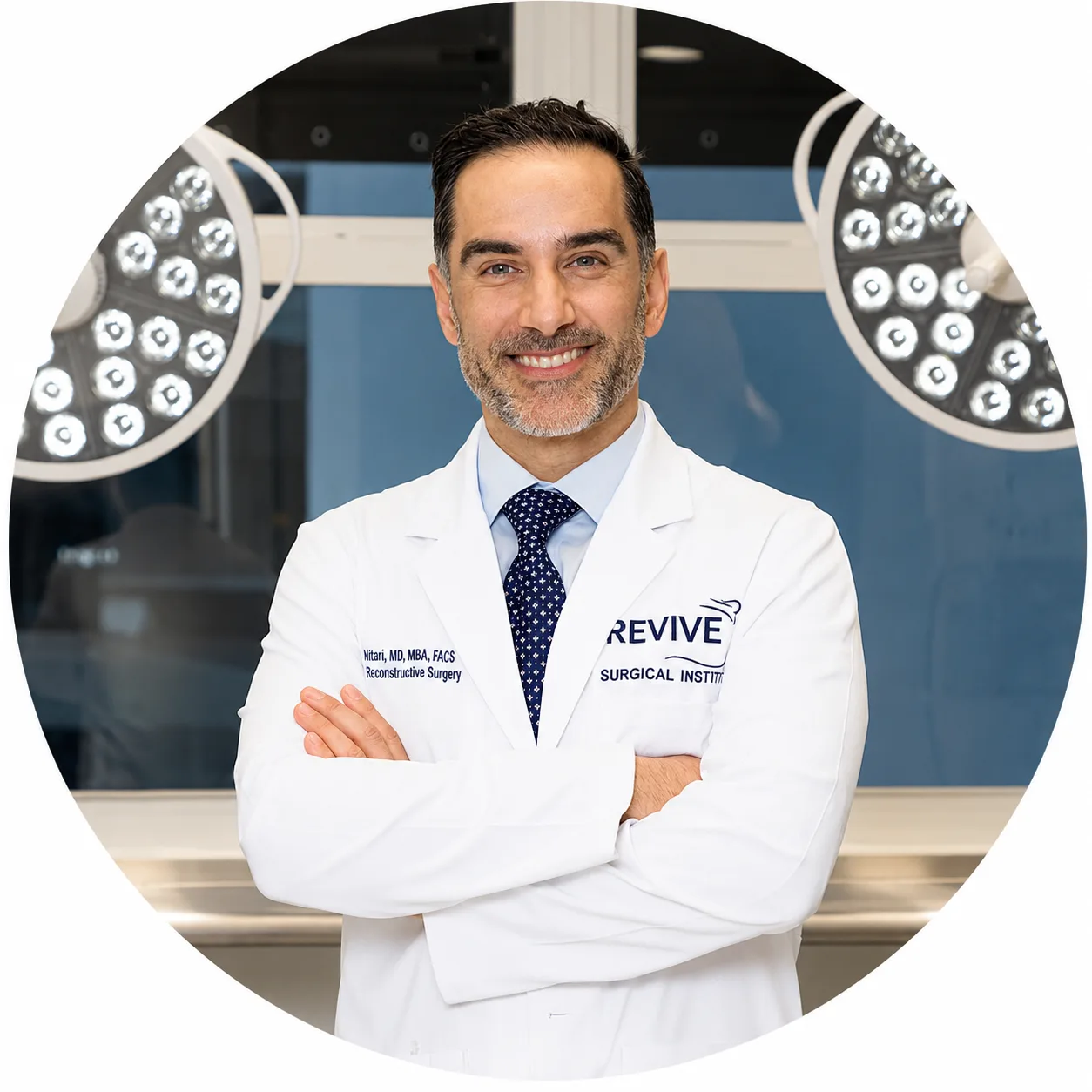
About the Author
Dr. Morad Askari, MD, MBA, FACS
July 28, 2026