
Alloclae® results are designed to be long-lasting – many patients consider the improvement effectively permanent, as the transferred fat gradually integrates with your own living tissue. Volume typically builds over the first 3 to 6 months, settles into its final shape, and then holds for years. Results typically last several years, with longevity depending on aging, weight stability, and aftercare.
What changes the outcome over time isn’t the treatment wearing off, but rather normal aging, weight shifts, and how well you care for the area. Below, we break down what Alloclae® is, what the month-by-month timeline looks like, and which habits protect your outcome in the long term.
Alloclae® is an allograft fat matrix, which is processed from donated human tissue. The donor cells are removed, leaving the natural framework of collagen, elastin, proteins, and growth-supporting structures behind.
Once placed into a soft-tissue deficit, that scaffold does what a traditional filler cannot: it invites your own cells in. Your body sends fibroblasts, fat cells, and new blood vessels into the framework, gradually replacing the space with your own living tissue. It provides the blueprint; your body does the construction.
At Revive Surgical Institute, Alloclae® is used wherever soft-tissue fullness has been lost:
Contour irregularities, depressions, and thin or hollow-looking areas
Non-surgical “liquid BBL” procedures to enhance buttock shape
Facial areas that have lost definition over time
It sits in the same family of thinking as fat transfer and other fat-based volume work – but without harvesting fat from a donor site on your own body, making it an option for slimmer patients who don’t have much fat to spare.
Temporary injectables like hyaluronic acid fillers are made of materials your body metabolizes and clears over months, which is why they need to be repeated on a schedule. Alloclae® works differently: the matrix is temporary by design, but as your body absorbs it, your own regenerated tissue is left in its place.
The process unfolds in stages:
Scaffold placement: The matrix provides immediate volume and shape to the treatment area.
Cellular integration: Fibroblasts – the cells that produce collagen – migrate into the scaffold.
Neovascularization: New blood vessels form throughout the matrix, supplying oxygen and nutrients so new tissue can thrive.
Remodeling and maturation: Your body replaces the graft with organized collagen fibers and living, vascularized tissue.
Because the final result is composed of your own cells, it behaves like your natural tissue. It stays, responds to weight changes, and ages naturally with you.
Most patients see their final result by around six months, and it holds steady from there. Because the correction is living tissue, there’s no expiration point where volume suddenly disappears – the area changes only as gradually as the rest of your body does.
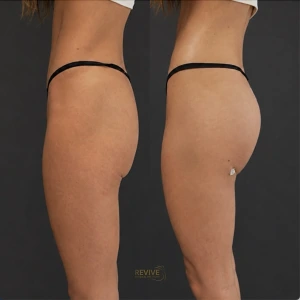
Right after your procedure at our Coral Gables practice, the area often looks fuller than the final result. Some of that early fullness is normal swelling, and some is the matrix itself, which hasn’t yet been remodeled. Mild tenderness, firmness, or a slightly lumpy feel in the first days is common and typically softens on its own.
Here’s the important part: don’t judge your result in week one. Many patients see their appearance dip slightly at weeks two to four as swelling resolves and graft fluid is absorbed, before new tissue growth becomes obvious. This “quiet phase” is expected and doesn’t mean the treatment failed. Our providers give every patient detailed post-procedure instructions to manage it.
A general timeline looks like this:
Weeks 1–2: Swelling and firmness. The area may look over-full.
Weeks 3–6: Swelling resolves. Volume may appear reduced. Your body is beginning to populate the scaffold.
Months 2–4: New soft tissue develops. Contour becomes smoother and more natural to the touch.
Months 4–6: The result matures. This is the point at which the final volume is assessed.
Beyond 6 months: Volume is stable. It now ages, gains, and loses along with your body.
At six months, your surgeon can assess whether the correction fully met your goals or whether a small additional treatment would refine it further. Results commonly last several years – a significant advantage for anyone seeking a durable, non-synthetic option for body and facial contouring.
Two patients treated the same way can have somewhat different long-term outcomes. Understanding why helps you set realistic expectations and protect your investment.
Blood supply to the treated area: The scaffold needs circulation to be populated. Healthy tissue regenerates more reliably than heavily scarred or previously operated areas.
Skin quality and thickness: Thicker, elastic skin displays new volume more smoothly; thin, lax skin may reveal contour edges. Pairing volume restoration with a skin-quality treatment, such as broadband light, can improve overall appearance.
Age and healing capacity: Younger tissue and a healthy metabolism support faster, more robust collagen production and regeneration.
Metabolic rate: Individuals with a faster metabolism may remodel tissue at a different rate.
Treatment area: Low-movement areas like the cheeks may hold longer than highly mobile areas or spots under constant pressure and friction. The buttocks generally hold volume well thanks to robust tissue and blood supply.
Overall health: Conditions affecting wound healing, circulation, or inflammation influence how efficiently your body builds new tissue.
Weight stability is the single biggest lifestyle factor. Because the new volume is your own tissue, significant weight loss can reduce it, and weight gain can enlarge it. Patients who are still actively losing weight – including those on weight-loss medications – achieve better long-term consistency by waiting until their weight has been stable for several months.
Smoking and nicotine use constrict blood vessels, working directly against the neovascularization the graft depends on and compromising both integration and longevity.
Pressure and trauma on the treated area in the early weeks can distort where new tissue forms.
Nutrition and hydration: Adequate protein and vitamin intake provide the building blocks for tissue repair and collagen synthesis, especially in the first three months. Hydration supports overall tissue health.
Sun protection: For facial treatments, protecting against UV damage helps preserve collagen and skin quality.
You can’t speed up biology, but you can avoid getting in its way. The habits below reflect our post-op care protocols at Revive Surgical Institute, where every patient receives a personalized aftercare plan.
Follow positioning and pressure instructions exactly. Take them literally – including how you sleep and sit (for example, avoiding sitting directly on the buttocks after a liquid BBL).
Skip vigorous exercise until cleared. Gentle movement is fine; heavy strain and impact in the early phase are not.
Protect the skin from sun. UV exposure works against skin quality and healing, especially in South Florida.
Stay hydrated and eat enough protein. Focus on nutrient-dense foods – your body is building tissue.
Avoid nicotine entirely during the healing window.
Keep your follow-up visits. They let our team monitor progress, catch small issues early, and assess your result at the right time.
Take consistent photos in the same lighting. Memory is unreliable; photos aren’t.
Be patient. Judging a regenerative treatment at four weeks is like judging bread at two minutes.
Because results are long-lasting, most patients don’t need a maintenance schedule. Follow-up treatment is usually considered for one of three reasons:
Refinement. After six months, you and your surgeon may decide a bit more volume would perfect the contour – especially in deeper defects that were always likely to need staging.
New changes over time. Aging brings ongoing soft-tissue loss in new areas. That’s a new concern, not the original treatment fading.
Body composition changes. Substantial weight loss may leave the area looking less full and worth revisiting.
Many patients also combine Alloclae® with complementary procedures for a more comprehensive outcome:
Skin-tightening and resurfacing, such as Halo Laser
Body contouring such as Lipo 360
Targeted arm contouring
So, how long do Alloclae® results last? Long enough that most patients consider them permanent. Volume matures over three to six months and then stays, because what’s left behind is your own living tissue – not a temporary material on a countdown. Weight stability, healthy circulation, sun protection, and disciplined early aftercare keep that month-six result looking the same years down the road.
Alloclae® suits patients who want natural, durable soft-tissue restoration – from non-surgical BBLs to facial rejuvenation – without harvesting fat from another part of the body.